
By Chris Leo, Movou
It’s probably not your website. That’s the part nobody tells you when your Domain Authority dropped from 22 to 15 overnight and you start tearing apart a site that was working fine yesterday. I’ve watched business owners burn a full month chasing a number that moved for reasons that had nothing to do with anything they did. So before you touch a single page, you need to know what that score actually measures and who it belongs to.
Domain Authority is a Moz product. It’s a prediction, on a scale of 1 to 100, of how likely a site is to rank. It isn’t a grade Google gave you. Google has said plainly and repeatedly that it doesn’t use it, and doesn’t have anything like a site-wide authority score of its own. So when your DA falls, the thing that changed is a third-party company’s estimate of you. Your rankings may not have moved an inch.
Why did my Domain Authority drop?
There are four real causes, and they are not equally likely.
1) Moz updated its index or its model. This is the most common one by a wide margin. Moz recalculates periodically, and when the calculation changes, scores move across the whole web at once. You did nothing. Your number moved anyway.
2) Other sites got stronger. This is the one that surprises people, so stay with me. DA is relative. It’s normalized against the rest of the web, which means it grades you on a curve. If the sites you’re measured against picked up links faster than you did, your score can fall with zero loss on your end. Nothing left your site. The curve moved under you.
3) You actually lost links. A site that linked to you went offline, redesigned, or pulled the page. Those votes disappear from the count. This is real and it does happen, and it’s still nowhere near the first thing to check.
4) Moz’s crawler is seeing less of your link profile than it used to. Third-party crawlers aren’t Google. They miss things, and what they miss changes between updates.
Does a Domain Authority drop hurt my Google rankings?
No. Not directly, and not by itself.
I know that sounds like I’m dodging the question. I’m not. Google’s own people have been flat about this for years: there is no Domain Authority signal in Google Search, and there’s no equivalent internal score they’re using instead. DA is Moz’s model of what Google might do. A model changing its mind about you is not the same event as Google changing its mind about you.
Here’s the part that matters. Your rankings are measurable and your Domain Authority is a guess about your rankings. So if you want to know whether something bad happened, go look at the measurable thing. Open Search Console, pull the last 90 days, and check whether your average position and your impressions moved on the queries you care about. If they didn’t, nothing happened. A number in a third-party tool went down and your business is exactly where it was.
If your position and impressions did fall in the same window, then you have a real problem, and Domain Authority still isn’t it. The DA drop is a symptom you noticed first because it’s the number sitting on a dashboard.
Did I lose links, or did everyone else gain them?
This is the question that separates a real problem from a phantom one, and almost nobody asks it.
Pull your referring domains today and compare them to your last snapshot. If the count is flat or up and your score fell, you didn’t lose anything. The curve moved. That’s a competitive-landscape event, not a site event, and the fix is to build links, not to audit your pages.
If the count genuinely dropped, find out which domains left and whether they mattered. Losing eleven links from a directory that got deindexed isn’t the same as losing one link from a trade association. Count is the cheap metric. Quality is the one that moved your score.
How much of a drop is normal?
A point or two either side, routinely, and it means nothing. Treat small movement as noise and don’t report on it.
Five points or more in one jump usually means one of two things happened: Moz ran an update, or you lost a batch of links that carried real weight. Check the Moz blog first. If they announced an update near the date your number moved, you have your answer and you can stop investigating.
And if your site is new, understand what you’re looking at. A new domain starts near the bottom and climbs slowly, and it can bounce around while it’s down there because there’s so little data underneath the score. That’s not a fault. That’s what a young site looks like. We wrote separately about what it means when your Domain Authority is sitting at zero, which is a different situation with different causes.
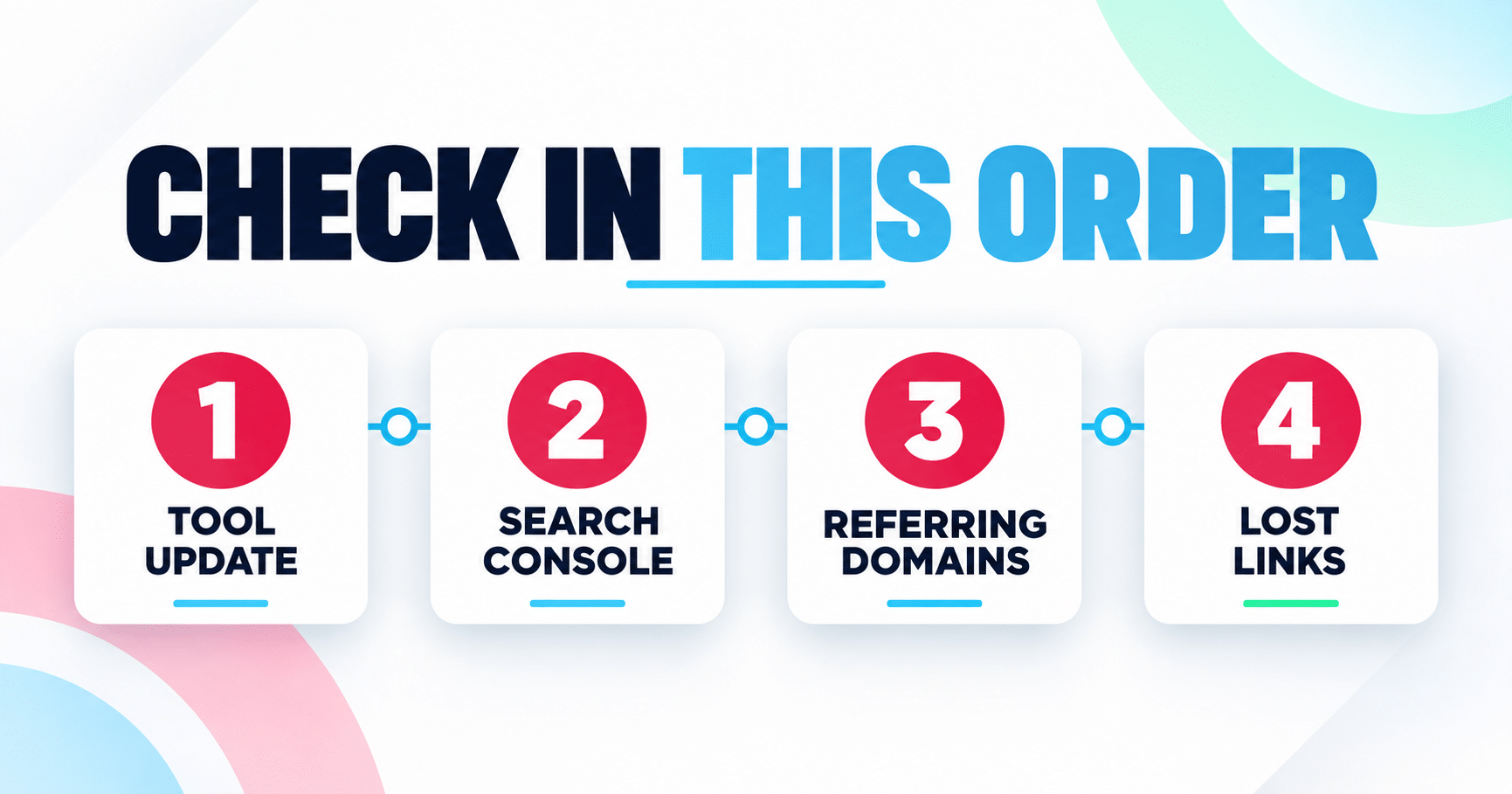
The four minute check, in order
Do these in this sequence. Most of the time you’ll stop at step two.
1) Check the Moz blog for an index or algorithm update near the date your score moved. If there was one, you’re done.
2) Open Search Console and compare average position and impressions for the last 90 days against the previous 90. If they’re stable, nothing happened. Stop.
3) Compare your referring domain count to your last snapshot. Flat or up means you lost nothing and the curve moved.
4) Only if steps two and three both show real decline, look at which specific links disappeared and whether the pages they pointed to still exist.
I know four checks sounds like nothing next to a full site audit. That’s the point. The audit is what you do after you’ve confirmed there’s something to audit.
What to watch instead
Here’s an honest admission from our own data. When I pull Movou’s Search Console, I can see people searching for this in at least four separate phrasings, and every one of them is a version of “it went down” rather than “it’s low.” Those are anxious searches. Somebody opened a tool, saw a number fall, and went looking for what they’d broken.
Most of them hadn’t broken anything.
I’ll take my own turn in the barrel here. Earlier this month I spent the better part of a week acting on a blank field that a reporting tool handed me. I treated the blank as a finding. It wasn’t. The tool simply couldn’t read the value, and the value was there the whole time. That’s the same mistake as chasing a DA drop: trusting what a dashboard says about a thing instead of going and checking the thing.
So watch the numbers that can actually become a customer. Search Console impressions tell you whether demand exists. Average position tells you whether you can win it. Calls, forms and booked jobs tell you whether any of it is working. Domain Authority tells you what one company’s model currently predicts, and you can’t deposit a prediction.
Key takeaways
- Domain Authority is Moz’s prediction, not a Google score. Google has said it doesn’t use it and has nothing like it.
- The most common cause of a drop is a Moz index or model update, followed by other sites gaining links faster than you. Both of those happen without you touching anything.
- Before you audit your site, check Search Console. If position and impressions are stable, nothing real happened.
- A move of one or two points is noise. A move of five or more is worth four minutes of checking, in order, starting with the Moz blog.
The short version
A falling Domain Authority score is a signal to go look at your actual search data, not a verdict on your website. Check the tool’s own update log, check Search Console, check your referring domains, and only then start pulling your site apart. Most of the time you’ll find the number moved and your business didn’t.
If your rankings really did slip and you want someone to tell you why instead of handing you a score, take a look at how we approach SEO or book a call and we’ll pull your numbers together.
Further reading: Search Engine Journal covered Google’s own rebuttal of the idea that it uses a Domain Authority signal, and Google’s guidance on creating helpful content is a better use of an afternoon than any authority score.