
By Chris Leo, Movou
You are not actually choosing between two channels. You are choosing when you want to start paying, and for how long. That is the part nobody explains when they pitch you. The Local Services Ads guy tells you to start with ads because leads show up this week. The SEO guy tells you to start with SEO because it compounds. Both of them are describing their own invoice. If you can only fund one of these this quarter, here is how to decide between LSAs or SEO without taking either salesperson’s word for it.
- LSAs buy you leads now and stop the day you stop paying. Local SEO builds slower and keeps working.
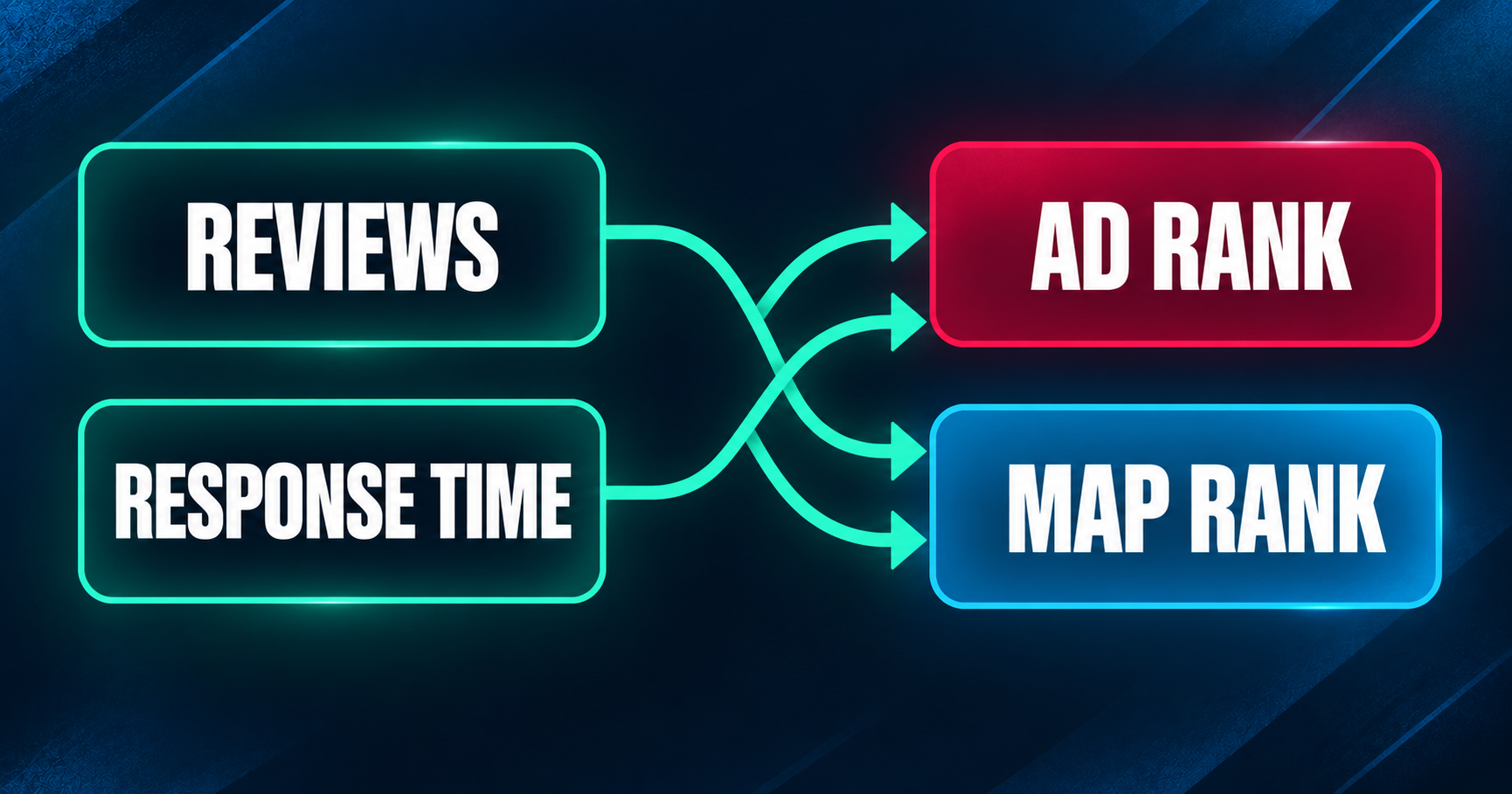
- They are not independent purchases. Google ranks Local Services Ads partly on your reviews and how fast you answer, which is exactly what local SEO work builds.
- If you have almost no reviews, ads will not save you. You will buy expensive leads and lose the ones you get.
- Picking wrong costs you a quarter, not a year. The real risk is funding the slow channel when you needed cash this month.
Which one gets you a lead faster?
Local Services Ads, and it is not close. You get verified, you set a weekly budget, and you can have the phone ringing inside a week or two. Local SEO, meaning the work that gets you into the map pack and onto page one for the searches happening in your service area, takes about 60 to 90 days before you see real movement. Organic search across your whole site is the marathon. That one runs about six months before it starts to compound.
So if you need work booked in the next 30 days to make payroll, this is already answered. Fund the ads. Nothing in the rest of this article beats needing money now.
But most owners asking this question are not in that spot. They have work, they want more, and they have one budget line to spend. For them the speed answer is the least interesting one.
What happens to your money if you pick wrong?
This is the question worth asking, and almost nobody answers it honestly.
If you fund LSAs and it was the wrong call, you spent the money and you have the jobs you booked. That is it. There is no residual. Turn the ads off and you are back to exactly where you were the day before you turned them on. You rented the leads.
If you fund SEO and it was the wrong call, you spent 90 days and you have some rankings, a cleaned-up profile, and more reviews than you had. The money is gone but the asset stayed. The cost of that mistake was time, not the whole investment.
I know that sounds like it settles the argument for SEO. It doesn’t, because the two mistakes are not the same size for every business. If you are seasonal and you burned your 90 days in your busy quarter, the slow channel was the expensive mistake. A roofer who spends June through August building rankings that arrive in October made a real error. The residual asset does not pay for a summer you already lost.
Why your review count decides whether LSAs even work
Here is the part that makes this whole comparison different from how it is usually presented, and it is the reason I would push back on anyone who tells you these are two separate decisions.
Google is explicit about how it ranks providers inside Local Services Ads. According to Google’s own documentation on ad rankings, your position is influenced by your review score and number of reviews, by your responsiveness to inquiries, and by the completeness of your profile. Missed calls can hurt you. Google says so directly.
Read that again with your budget in mind. The things that determine whether your ads win the auction are reviews, response speed, and profile quality. Those are the exact same things a competent local SEO engagement spends its first month building.
So the honest version of the question is not “which channel do I like better.” It is: do I already have the foundation that makes the ads work? If you have 60 reviews at 4.8 and somebody answers the phone on the second ring, LSAs will probably perform, and funding them first is a reasonable call. If you have 7 reviews and calls go to voicemail after 5pm, the ads are going to be an expensive way to learn that.
Think of the website and the profile as your house. Under every house there has to be a foundation or the whole thing collapses. Ads are not the foundation. They are the thing you park in the driveway.
In our work with service businesses, the accounts that struggle most with Local Services Ads are almost never the ones with the smallest budget. They are the ones who switched the ads on before they had the reviews to compete in the auction, and then concluded that the channel does not work for their industry. The channel worked fine. They entered a contest scored on reviews without any.
Can you run both on a small budget?
Yes, and this is what I recommend more often than either pure answer, but not in the way most people split it.
The bad split is taking your budget and cutting it in half. Half a budget in LSAs gets you leads inconsistently, because you run out of daily budget in the morning and disappear for the rest of the day. Half a budget in SEO gets you a slower version of a slow channel. You end up with two things that are almost working, which in practice is two things that are not working.
The split I would actually run looks like this:
- Month one, all foundation. Reviews, profile, response process, the unglamorous stuff. It sounds like nothing. It is the thing that decides whether either channel performs.
- Month two, turn LSAs on at a real daily budget in one service and one tight area. Not everything you do, not your whole county. One thing, one place, enough budget to stay live all day.
- Month three onward, let the ads fund the SEO. The jobs the ads book pay for the slow channel, and by then you have review flow feeding both.
That sequence works because step one raises the ceiling on step two, and step two pays for step three. Splitting the budget on day one does none of that.
What about the businesses that cannot run LSAs at all?
Worth saying out loud, because it quietly resolves this for a lot of readers. Local Services Ads are only available in specific service categories and specific countries, and every provider has to pass Google’s verification, which for many categories means license and insurance checks. If your category is not eligible, the comparison is over and you have your answer.
Check eligibility before you spend a single hour agonizing over the split. It takes ten minutes and it is the cheapest way to make this decision. If you want the mechanics of how the ads work before you check, we wrote the full guide to LSA marketing separately, and this article assumes you have either read it or already been pitched.
How to pick, in about five minutes
Answer these four honestly. Do not answer them the way you wish they were true.
- Do I need booked work in the next 30 days? If yes, fund the ads and stop reading. Cash flow beats strategy.
- Do I have at least 20 to 25 real reviews at 4.5 or better? If no, you are not ready to compete in an auction scored partly on reviews. Fix that first, whether you pay someone or do it yourself.
- Does a human answer the phone during business hours, every time? If no, ads will charge you for leads you then lose. Google counts missed calls against you, and so does the customer.
- Is my busy season more than four months out? If yes, you have room to fund the slow channel and arrive in time. If it is six weeks out, you don’t.
Two or more “no” answers in questions two and three means the money goes to foundation work this quarter regardless of what you find more exciting. That is not the fun answer. It is the one that stops you from buying leads you cannot convert.
The honest asterisk
All of this assumes somebody is measuring. If you fund either channel and you cannot tell me 90 days from now how many calls came from where, you did not run a test, you bought a lottery ticket. Call tracking on the ads, and Search Console on the organic side. Neither one is optional, and neither one is expensive.
And it doesn’t matter if you rank number one for a keyword nobody searches for. Same logic applies to ads. Winning an auction in a category that generates two searches a month in your town is not a win.
If you want a straight answer on which one your business should fund first, we do that read for free and we will tell you if the answer is neither. Take a look at how we approach organic traffic, or just send us your situation and we will tell you where your next dollar actually goes.
Frequently asked questions
Local Services Ads are much faster. Once you are verified and funded you can have leads coming in within a week or two. Local SEO generally takes 60 to 90 days to show real movement, and site-wide organic search takes about six months before it starts to compound.
If you fund ads and it was wrong, you keep the jobs you booked and nothing else. There is no residual. If you fund SEO and it was wrong, you lost time but kept the asset, meaning rankings, a cleaner profile and more reviews. The SEO mistake is usually cheaper unless you burned your busy season waiting.
Yes. Google states that ad rank within Local Services Ads is influenced by your review score and number of reviews, your responsiveness to customer inquiries including missed calls, and your overall profile quality. This means ads and local SEO depend on the same underlying assets.
Yes, but do not split the budget evenly on day one. Spend month one on foundation work like reviews and response process, month two on Local Services Ads at a real daily budget in one service and one tight area, then use the jobs the ads book to fund the SEO from month three onward.
No. Local Services Ads are limited to specific service categories and countries, and providers must pass Google verification, which for many categories includes license and insurance checks. If your category is not eligible, the decision is already made for you.