
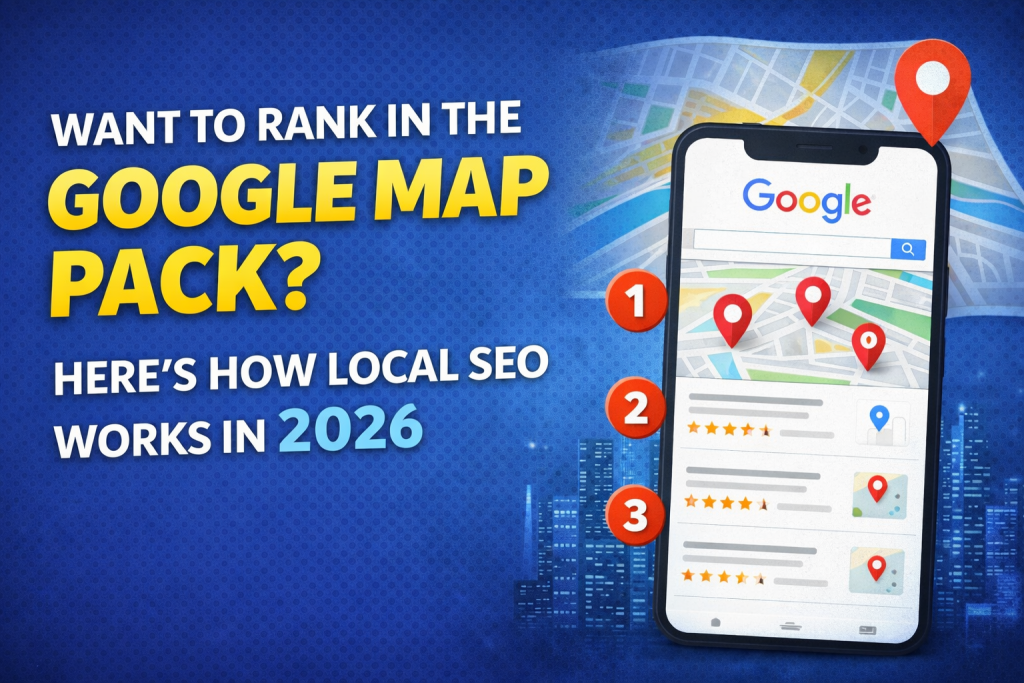
Every small service business owner wants to show up in the top three results on Google Maps—the Local 3-Pack. That’s where the calls, clicks, and real money live. The problem is, most owners have no idea how Google decides who gets those spots, especially if you’re just a one-person business working from a home office or truck. The good news: you can compete and win with the right moves.
What the Local 3-Pack Actually Is
The Local 3-Pack is the box of three businesses that shows up with a map at the top of local searches like “plumber near me” or “estate planning lawyer [city].” Each listing shows your name, rating, reviews, hours, and key actions like “Call,” “Directions,” and “Website.” In 2026, more than half of local clicks and calls go to those three spots—so ranking there matters a lot.
How Google Chooses Who Ranks (In Plain English)
Google has a long list of signals, but most of it boils down to three big ideas:
- Relevance – How closely your profile and website match what the searcher is looking for.
- Distance – How close you are to the person searching (you can’t fully control this).
- Prominence – How “popular and trusted” you look online (reviews, activity, links, engagement).
Even if you’re a solo operator, you can crush the relevance and prominence parts. That’s how you beat bigger competitors in your area.
Step 1: Fully Optimize Your Google Business Profile
Your Google Business Profile (GBP) is the foundation of Map Pack rankings. Treat it like your #1 online asset.
- Claim and verify your profile. Make sure you’ve claimed your listing and completed verification (mail, phone, or email).
- Use the right categories. Pick the most accurate primary category (e.g., “Plumber,” “Family Law Attorney,” “Pest Control Service”), then add relevant secondary categories.
- Fill out every field. Business name, phone, website, hours, service area, services, description—all of it should be complete and accurate.
- Write a clear, keyword-rich description. Mention your main services and city: “We provide residential and commercial HVAC repair, installation, and maintenance in [City] and surrounding areas.”
- Add real photos. Upload photos of yourself, your team, vehicles, jobs, and your logo. Skip boring stock images—Google and customers both prefer real-life visuals.
If you want this done with more strategy and less guesswork, our Local SEO services are built to maximize visibility in Maps and local search.
Step 2: Make Your Website Support Local Rankings
Google doesn’t just look at your profile—it also scans your website to confirm what you do and where you do it.
- Create or refine pages for your main services that clearly mention your city or service area.
- Keep your Name, Address, and Phone (NAP) info consistent with your GBP.
- Embed a Google Map on your contact or location page to connect your site and profile.
- Ensure your site loads fast and works well on mobile—most local searches happen on phones.
Dialing in these basics dramatically improves your odds of showing up in that top 3 slot instead of buried below the fold.
Step 3: Use Reviews as a Ranking and Sales Weapon
Reviews aren’t just social proof—they’re a major Map Pack ranking factor in 2026. Google tracks:
- How many reviews you have
- How recent they are (steady “review velocity” beats big spikes)
- Your average star rating
- What keywords people mention in their reviews (e.g., “water heater repair in [city]”)
Build a simple habit: after every successful job, ask for a Google review and send your direct link. As a one-person shop, you actually have an edge—people know they’re dealing with the owner, and that personal connection often leads to stronger, more detailed reviews.
Step 4: Build Local “Signals” Around the Web
Google wants to see that you’re a real business that the local community recognizes.
- Get listed in relevant local directories (chamber of commerce, trade organizations, reputable industry sites).
- Make sure your business info is consistent everywhere—same name, address, and phone.
- Earn a few local backlinks (links pointing to your site) from community blogs, sponsorships, or partners.
You don’t need hundreds. A small number of high-quality, locally relevant links can move the needle for solo operators.
Step 5: Stay Active So Google Knows You’re Alive
Google pays attention to engagement and freshness. A dead profile sinks over time.
- Post updates to your GBP at least once a month—offers, seasonal reminders, recent projects, FAQs.
- Keep your hours updated (especially holidays and seasonal changes).
- Respond to every review with a short, personal reply.
These small actions send big signals that you’re active, reliable, and worth showing ahead of competitors who set their profile up once and never touch it again.
Can a One-Person Business Really Compete?
Yes. Google doesn’t rank based on how many employees you have—it ranks based on relevance, proximity, and how strong your online signals are. A solo business with an optimized profile, solid website, consistent reviews, and a few local links can absolutely outrank bigger names that ignore their Local SEO.
If you want help turning all of this into a clear plan and execution, check out our Local SEO services or dive deeper into practical tactics on the Movou blog. Get your foundation right once, and the Map Pack can feed you a steady stream of high-intent leads for years.